

Sustainability & GRP recycling
Make the whole-life case with evidence.
Material selection should connect durability, maintenance, transport, installation, service life and end-of-use planning—not rely on a blanket sustainability claim.
Circular GRP
Keeping valuable material working.
Repurpose. Recycle. Put material to work again. Our sustainability offering connects efficient design and fabrication with practical options for what happens after a component’s current use.
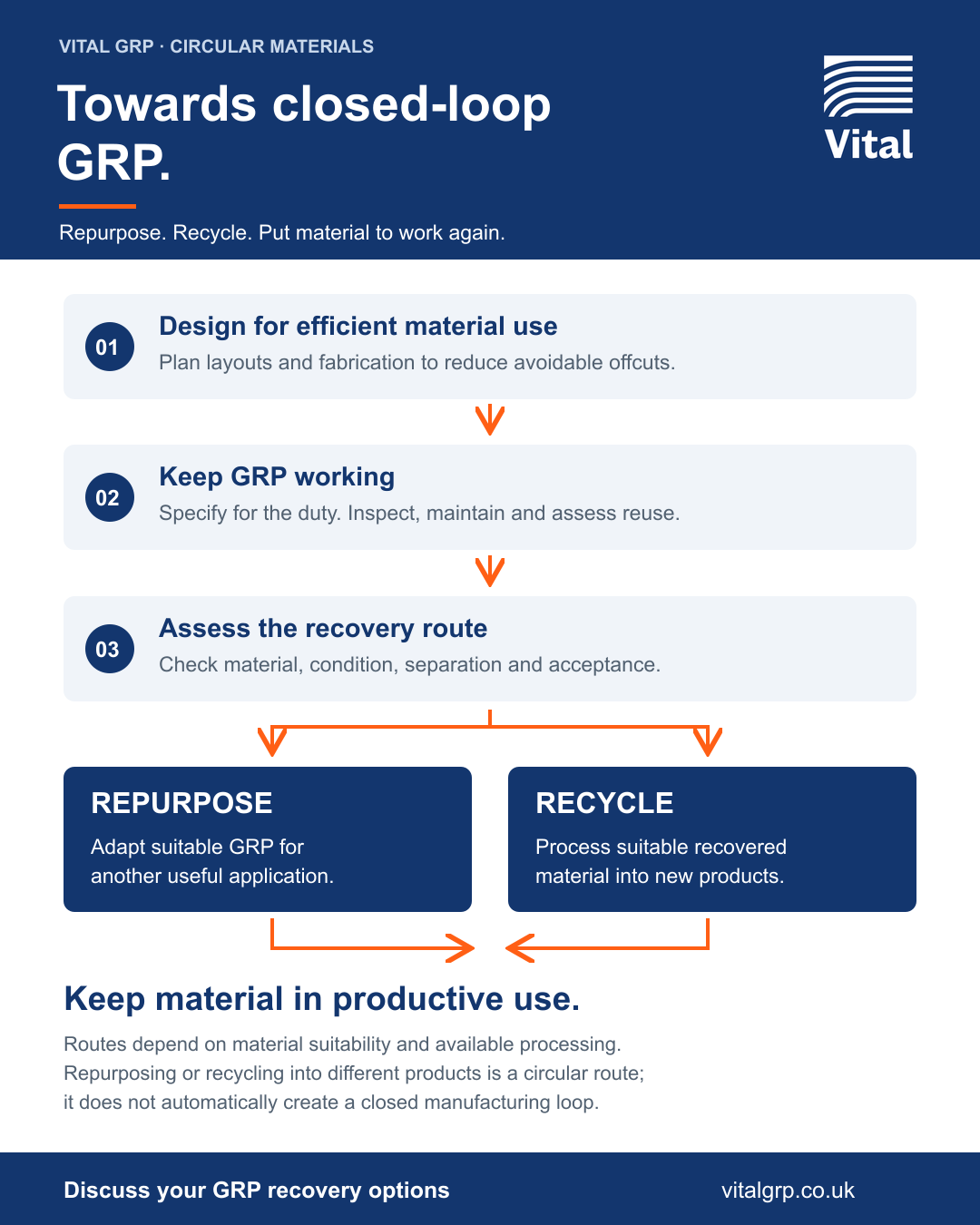
At Vital GRP, we repurpose suitable GRP for new applications or recycle recovered material into new products, subject to its condition and the available processing route. Circular GRP brings that approach into the project conversation earlier, from material selection and cutting plans through to recovery assessment.
Towards closed-loop GRP
Our direction is to keep useful material in circulation and support the transition towards closed-loop GRP systems. Reuse in another application and recycling into different products are valuable circular routes. They do not automatically mean that material returns to the same product or manufacturing process.
Recovery is assessed for each project. Acceptance, quantities, preparation, transport and the receiving process need to be agreed before any material is sent.
Design efficiently. Keep GRP working.
Coordinated layouts and fabrication can reduce avoidable offcuts. In service, the right specification, inspection and maintenance help components fulfil their intended duty. When requirements change, review whether suitable components can continue in use or be adapted before deciding on replacement.
Repurpose suitable components
Assess dimensions, material records, condition, previous exposure and the proposed new application. Reuse in an access or structural system needs the appropriate technical review: an intact-looking component is not, by itself, evidence that it is suitable for a different duty.
Recycle into new products
Where repurposing is unsuitable, assess the available recycling route for the recovered material. Product composition, contamination, separation and the receiving process determine what can be accepted. Confirm the actual destination and outcome before describing material as recycled.
Agree the recovery record before collection
For an agreed recovery project, ask which records can be supplied: material description, accepted quantity or weight, collection or delivery date, receiving organisation and the confirmed reuse or recycling route. Distinguish material collected from material actually processed. Confirm transport, preparation, charges and available outcome evidence in the project agreement; these vary with the material and receiving route.


Have GRP offcuts or redundant components?
Send photographs, approximate quantity or weight, dimensions, location, available product information and any known contamination or previous exposure. Include your timescale and whether the material is already separated. We can then discuss the repurposing and recycling options available for your project.
Whole-life decisions
Compare the complete requirement.
Vital GRP helps project teams assemble the product, project and lifecycle information relevant to the decision, including available declarations, test evidence and recovery routes.
Consider interventions over time.
Assess exposure, corrosion risk, inspection, access and maintenance requirements across the expected service period.
Use the right system, not simply more material.
Coordinate spans, profiles, panel layouts and fabrication to reduce avoidable waste and unnecessary site work.
Account for handling and installation.
Lower component weight can influence transport, lifting, temporary works and installation planning.
Bring current records together.
Provide applicable product data, test information, certificates and available environmental evidence with revision and scope visible.
Define the route before end of use.
Consider reuse, separation, return and recycling opportunities when designing and documenting the system.
Connect claims to project evidence.
Support the project team with relevant, controlled information for the applicable assessment route.
Vital GRP · Corporate sustainability reporting
Measure our operations.
Improve where it matters.
Vital has published sustainability reporting covering direct operations, purchased energy and the wider value chain. It informs our priorities for procurement, logistics, travel and material efficiency.
Look beyond the factory gate.
Our reporting considers Scopes 1, 2 and 3, including the supply chain. For tender submissions, request the report with its reporting period, organisational boundary and calculation basis.
Generation and practical investment.
On-site renewable generation supports our operations and six electric-vehicle charging points, with surplus electricity exported to the grid. Use dated generation and export records for any quantified procurement claim.
Connect measurement to action.
Supplier engagement, transport and logistics, business travel, commuting, efficient material use and recovery planning form part of our ongoing sustainability work.
Need the reporting behind your tender?
Tell us the reporting period and evidence your client requests. We can identify the available corporate report and supporting information for your submission. Product carbon data and EPDs have a separate scope from company-wide reporting.
Defined deliverables
Show what supports the decision.
Evidence is identified by product, project and revision so the limits of each document remain clear.
How it works
Build a defensible evidence route.
Start with the decision the project needs to make, then assemble only the relevant evidence.
Define
Identify the assessment, specification or client requirement.
Map
Connect the requirement to the selected products and project scope.
Evidence
Assemble current records and identify any gaps or limitations.
Handover
Provide the agreed information with revision and applicability clear.
Questions
Sustainability evidence questions.
GRP performance and environmental evidence vary by product, system and project context.
Does Vital provide environmental product information?
Vital can provide available project-relevant environmental and product evidence and make its scope and revision clear.
Can GRP be recycled?
Recovery depends on material, condition, separation and the available route. Vital GRP can discuss project-specific return and recycling options.
Is GRP always more sustainable than steel?
No blanket comparison is responsible. Service environment, maintenance, mass, transport, installation and end-of-use routes all affect the whole-life decision.
Can this support BREEAM submissions?
Relevant product and project information can be assembled for the assessor or project team, subject to the specific scheme and evidence requirement.
Start with the requirement
Need a clearer whole-life evidence route?
Share the product, project and assessment requirement so the relevant evidence can be identified.
Carbon evidence under development
Methodology before marketing.
Vital GRP is developing product carbon-footprint information for pultruded GRP profiles with reference to ISO 14067:2018 and PAS 2080:2023. The current model is indicative and is not an independently verified EPD.
Request available carbon information →BREEAM and GRP · Project evidence
Build the submission around your assessment.
GRP does not automatically earn BREEAM credits. BREEAM assesses the building or asset under its applicable scheme; BRE does not approve individual products as “BREEAM compliant”. Start with the registered scheme, version and assessment stage, then agree the required evidence with your assessor.
For a GRP access package, assemble the product, design and delivery records that answer those requirements. Keep corporate carbon reporting, product declarations and project calculations clearly identified: they address different scopes.

Life-cycle information
Request an applicable verified EPD where available, or identify the status and limitations of other environmental data. Record the product, declared unit, life-cycle stages, geography and revision. Compare equivalent performance and service-life assumptions rather than unrelated headline figures.
Responsible sourcing
Keep the manufacturer, fabricator and supply route traceable. Ask which management-system and responsible-sourcing records the assessor requires. A quality certificate should not be relabelled as an environmental declaration or treated as evidence for every sourcing requirement.
Durability in service
Define the exposure, resin system, temperature, loading, connections and surface requirements. Record inspection, cleaning and expected interventions. The whole-life comparison should explain why its maintenance and replacement assumptions suit this application.
Material and site waste
Retain coordinated drawings, cutting schedules, delivered quantities and waste records. Distinguish material avoided through layout planning from material collected for recovery. Record the actual destination of offcuts and packaging before claiming recycling outcomes.
Adaptation and disassembly
Plan accessible connections, removable panels and replacement components where appropriate. Keep the accepted drawings and dismantling information. Confirm that future access and alteration remain practical without assuming every mechanically fixed system can be reused unchanged.
Recovery at end of use
Identify the material, condition, separation requirements and an available receiving route. Confirm acceptance, transport and responsibilities for the particular project. A proposed recycling process is not evidence that this installation has been recovered or that a take-back service is guaranteed.
Send the assessment requirements with your enquiry.
Include the scheme and version, assessor’s evidence request, product schedule, drawings, quantities, programme and intended service environment. Vital can identify available records and the information still to be developed for the package.
Discuss your sustainability submission →For the wider material decision, use our GRP versus galvanised steel whole-life comparison. Request current product and technical records through the Assurance Centre.
Assessment references: BRE guidance on products and BREEAM · BREEAM New Construction. Issue names, evidence requirements and credit routes should be checked against the registered scheme; this checklist is not a credit award.