
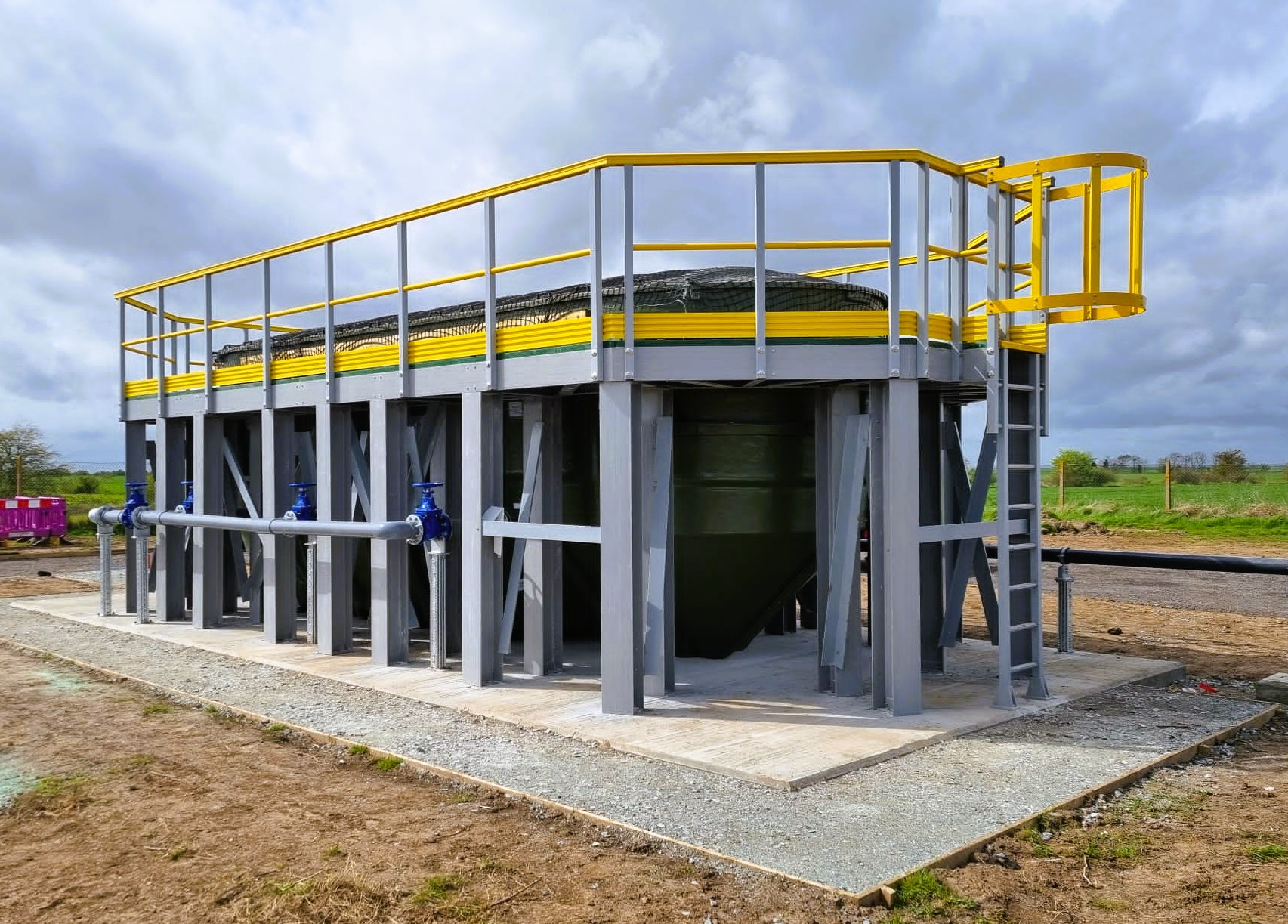
Vital GRP · Engineering insight
Repeatable GRP access systems
Standardise the common details. Review each site.

TECHNICAL INSIGHT · MODULAR ACCESS · PROGRAMME DELIVERY
The fiftieth access platform in a programme should be easier to deliver than the first. If every site restarts from a blank drawing, the programme is failing to capture its own engineering knowledge.
Multi-site programmes appear across water, power, data centres, rail, industrial estates and national maintenance frameworks. The physical sites differ, but many requirements repeat: access to valves, plant, roofs, electrical equipment, service routes and changes in level.
The opportunity is not to make every structure identical. It is to make the engineering language repeatable.
Standard product and standard system are different things
A standard product has fixed dimensions and a defined configuration. A standard system can allow dimensions, access directions, support arrangements and load cases to vary within controlled rules.
For example, a modular platform family may define preferred structural profiles, beam arrangements, connection details, guardrail interfaces, stair geometry, baseplates, grating fixings, allowable span ranges and drawing conventions. One site may use a three-metre platform and another a five-metre platform, but both can be derived from the same controlled engineering architecture.
Build an engineering envelope
Repeatability depends on knowing where the standard system is valid. The design team should define an envelope covering parameters such as loading, platform height, span, support conditions, environmental exposure, access geometry and allowable modifications.
A useful digital workflow can then classify each requirement as:
- Within standard configuration — the requirement sits within the established design envelope.
- Designer review — one or more inputs require engineering confirmation.
- Outside envelope — the requirement needs a bespoke solution.
This preserves engineering control while removing unnecessary repeated administration.
Standardise connections first
Connections are a strong place to create repeatability because they influence design, fabrication, installation, inspection and future modification. Controlled families can include beam-to-column joints, beam splices, braces, handrail posts, stair landings, baseplates and removable sections.
Each common detail can be checked once thoroughly, documented, assigned controlled components and then reused within its approved limits. Project-specific loads and geometry still need checking, but the connection does not need reinventing every time.
Make survey information consistent
Programme efficiency is lost if every surveyor captures different information. A standard site-capture brief can define the dimensions, photographs, support data, obstructions, plant clearances, access routes and service information required for each asset type.
For difficult brownfield sites, 3D site capture can provide a consistent digital basis for coordination.

Standardise the technical pack as well as the structure
Repeatable hardware creates only part of the saving. Each project also needs drawings, calculations, material data, connection information, design assumptions, installation guidance, inspection information and assurance evidence.
A controlled technical-pack template can pre-populate the common evidence and insert project-specific information such as dimensions, loads, reactions, revisions and design exceptions. This reduces document recreation while improving consistency.
BIM objects need engineering rules behind them
A BIM object is useful when it communicates more than geometry. For configurable access systems, the digital object should connect to known section properties, component families, clearance requirements and project metadata. Otherwise it risks becoming a visual placeholder disconnected from the final engineered system.
Vital’s CAD, Structural Design & BIM capability is intended to connect coordination information to the design and fabrication process.
Procurement can become simpler
Once a system is controlled, programme procurement can move beyond buying disconnected materials. Framework pricing can be structured around platform families, access modules, standard components, design services and defined exception routes.
That can improve budget predictability and make early-stage estimates more useful, particularly where a programme has many similar sites but incomplete final geometry.
Feedback should improve the next site
Repeatable systems should learn. Installation feedback may reveal that a connection can be simplified, a tolerance increased, a packaging sequence improved or a standard module resized. Those lessons should feed back into the controlled system rather than remaining with one project team.
Do not standardise away genuine differences
A common system must still recognise different loads, fire requirements, electrical environments, chemical exposure, support conditions and operational constraints. If the project lies outside the envelope, the correct answer is designer review or bespoke engineering—not forcing it through the standard route.
The programme model
- Define common requirement families.
- Create controlled engineering envelopes and connection details.
- Standardise survey inputs and digital models.
- Configure each site and identify exceptions.
- Generate project drawings and technical packs.
- Fabricate repeatably under controlled conditions.
- Capture installation feedback and improve the system.
Standardise the repeatable. Escalate the exceptional. Let every completed site make the next one easier.
Have a repeated access requirement across multiple sites?
Vital GRP can help turn recurring access requirements into controlled platform, walkway, stair and guardrail families with defined design-review routes.
Discuss programme standardisationTurn your requirement into an engineering brief.
Bring the drawings, site constraints and performance requirements into one review.