
Vital GRP · Engineering insight
Specifying GRP fire performance
Define the fire question before selecting the product.

TECHNICAL INSIGHT · FIRE PERFORMANCE · SPECIFICATION
“Fire-retardant GRP” sounds precise. It is not.
GRP products can use different resin systems, additives, reinforcement arrangements, thicknesses, surface treatments and constructions. Fire behaviour also depends on what property is being measured and how the product is installed in its end-use condition.
The specifier should define the required performance and evidence—not rely on a generic fire-retardant label.
Start by separating different fire questions
Several terms are often used interchangeably even though they describe different performance characteristics.
- Reaction to fire: how a product contributes to ignition, flame spread, heat release, smoke or flaming droplets under defined test conditions.
- Fire resistance: how an element performs for a period when exposed to fire, potentially considering loadbearing capacity, integrity or insulation depending on the element and test route.
- Smoke and toxicity: characteristics that may be separately important for certain industrial, transport or enclosed environments.
- Flame spread: one particular aspect of fire behaviour, not a complete description of system performance.
The project needs to identify which of these properties actually matters.
Reaction-to-fire classification is system-specific
BS EN 13501-1:2018 classifies construction products using reaction-to-fire test data. Check the applicable edition and the evidence for the specified end use. Product form, thickness, orientation, substrate, joints, fixings and mounting can affect the field of application.
That means a classification achieved by one panel construction should not automatically be transferred to a different profile, thickness or fixing arrangement unless the supporting evidence allows it.
Building regulations and industrial specifications are not always the same route
Where GRP forms part of building work, identify the applicable jurisdiction, regulations and guidance. In England, the 2025 Approved Document B amendments removed national-class references for reaction to fire and roofs, subject to the stated transitional arrangements. Fire-resistance changes follow a different timetable; do not treat these as one interchangeable change.
The correct specification therefore begins with the project’s regulatory and contractual context rather than a supplier’s standard product description.
Resin system matters
Polyester, vinyl ester, phenolic and other resin systems can be formulated for different performance objectives. Fire additives may change reaction-to-fire behaviour, while resin selection also affects chemical resistance, mechanical properties, smoke characteristics, cost and manufacturing route.
The designer should therefore avoid selecting a resin purely because it carries a familiar marketing term. The resin must fit the complete environmental and performance requirement.

Grating, profiles and sheets may need different evidence
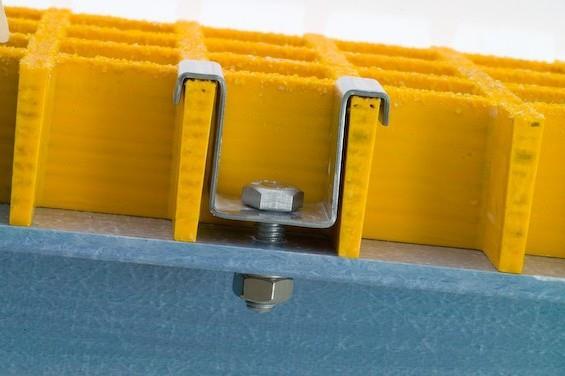
An access system can contain moulded grating, pultruded profiles, solid sheets, stair treads and connection components. These products are geometrically different and may not share one universal fire classification. The technical submittal should make clear which evidence applies to which component.
Fire resistance is not the same as reaction to fire
A product can have a reaction-to-fire classification without that classification establishing how long a loadbearing access structure will retain capacity during a developed fire. If structural fire resistance is required, the project must define the necessary performance and the evidence route separately.
Do not ignore fixings and connections
The access structure is a system. Metallic fixings, bonded connections, support details and adjacent construction may influence behaviour. If the fire strategy relies on a tested configuration, changes to those details may fall outside the evidence.
Smoke can matter as much as flame in some environments
Enclosed plant rooms, transport infrastructure, tunnels and certain nuclear or process environments may place particular emphasis on smoke generation or toxicity. These requirements need to be stated explicitly so the manufacturer can provide relevant evidence rather than assuming a flame-spread test answers the question.
The specification should ask for the report, not just the claim
A robust submittal should identify the test or classification standard, laboratory or certification body where relevant, product tested, thickness or configuration, result, field of application, report reference and revision. A one-line datasheet statement is weaker evidence than a controlled report showing what was actually assessed.
A practical GRP fire-performance brief
- What regulation, standard or client specification applies?
- Is the requirement reaction to fire, fire resistance, smoke, toxicity or another property?
- What classification or performance level is required?
- Which GRP products are in the system—profiles, grating, sheets, treads?
- What is the end-use orientation and fixing arrangement?
- Does the test evidence cover the proposed thickness and configuration?
- Are there maintenance requirements associated with any coating or treatment?
- What records need to be included in the technical submittal?
Write performance specifications, not adjectives
“Fire-retardant”, “low smoke” and “self-extinguishing” may be useful descriptions, but they are not substitutes for defined test criteria. The more safety-critical the environment, the more important it becomes to connect the specified performance to controlled evidence.
For nuclear and other high-assurance contexts, see Technical assurance and evidence.
Specify the fire question first. Then select the GRP system that has evidence answering that question.
Need to define GRP fire performance?
Vital GRP can review the project specification and coordinate the required product evidence into the technical submittal.
Visit the Assurance CentreDiscuss the specificationSource references
Turn your requirement into an engineering brief.
Bring the drawings, site constraints and performance requirements into one review.