
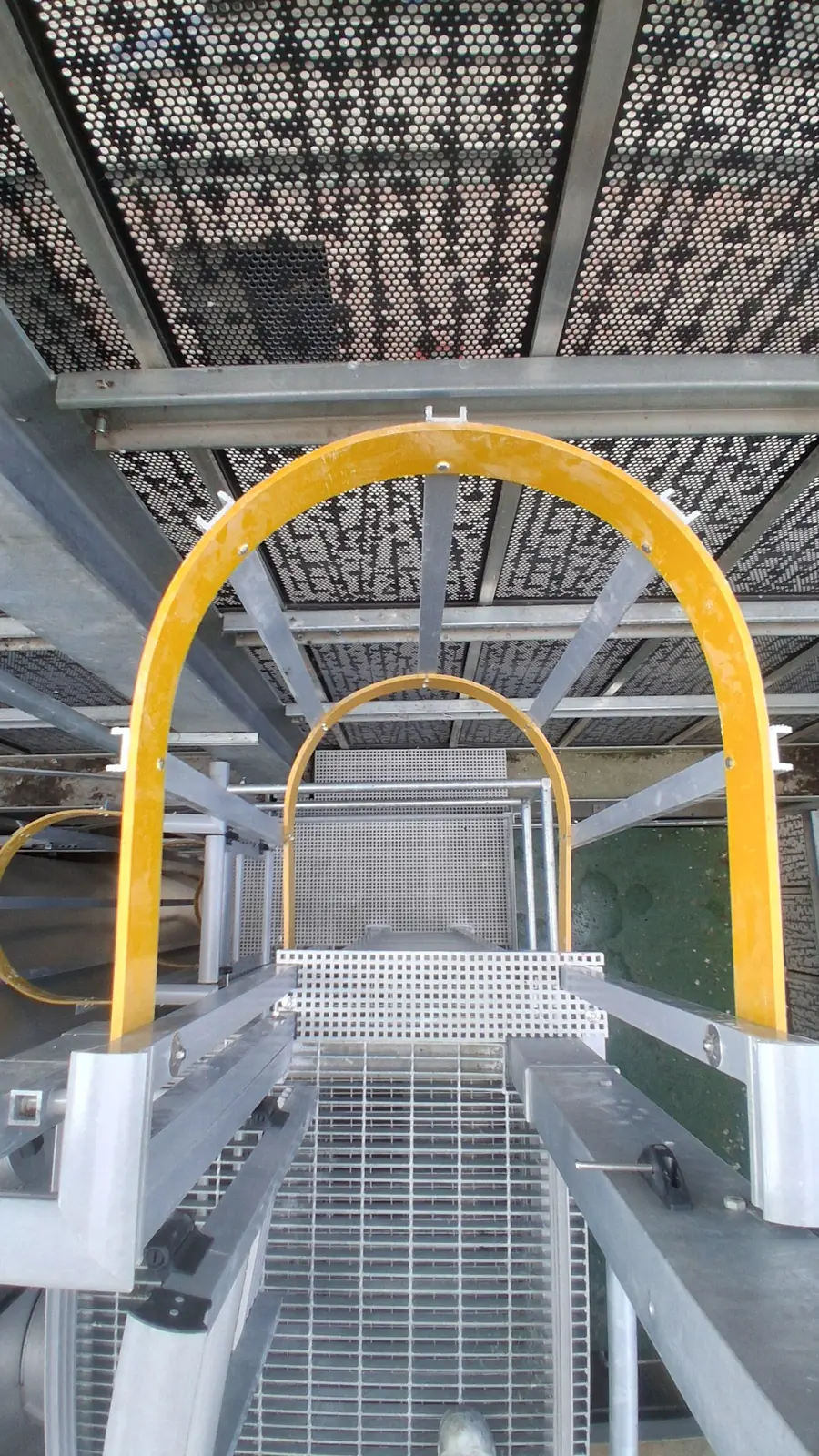
Vital GRP · Engineering insight
GRP ladder or GRP stair?
Choose the access method around the working task.

TECHNICAL INSIGHT · LADDERS & STAIRS · SAFE ACCESS
A ladder often occupies less space than a stair. That does not make it the default answer when space is tight.
The correct permanent means of access should be selected from the task, frequency of use, available space, fall risk, user movement and applicable standards. BS EN ISO 14122-1 provides the selection framework for fixed access to machinery, with Part 3 covering stairs and Part 4 covering fixed ladders.
Choose the access method from how people need to use it—not from whichever symbol fits most easily on the drawing.
How often will people use it?
Frequency is a major design input. A route used routinely by operators should generally be approached differently from occasional inspection access. The more frequent the movement, the more important ease of ascent, two-way movement, tool carrying and fatigue become.
What are users doing at the top?
If the user needs to carry tools, samples, replacement components or equipment, a ladder may impose practical limitations. A stair can allow more natural movement and better support for repeated access. Conversely, a fixed ladder may remain appropriate for occasional access where a stair would be disproportionate or impossible to accommodate.
Space is important—but not the only factor
Stairs require horizontal projection and landings. Fixed ladders occupy a smaller footprint but introduce different fall-protection and transition requirements. The designer should first ask whether the site can be reorganised to provide a better means of access before defaulting to the most compact solution.
Transitions at the top and bottom matter
Transitions deserve explicit review: coordinate the upper landing, gate, handhold, guardrail opening and lower approach as one system. An awkward step on or off can undermine an otherwise well-designed route.

Fixed ladders need their own engineering
BS EN ISO 14122-4 sets requirements for fixed ladders in its scope. Depending on the application and height, the design may need to address ladder geometry, rest platforms, fall protection, access gates, clearances and attachment to the supporting structure.
A GRP ladder should therefore not be treated as a set of rungs attached to a wall. The stiles, rungs, brackets, fixing points and supporting structure form a load path that needs verification.
GRP can offer useful material properties
In wet, chemical and electrically sensitive environments, GRP’s corrosion resistance and electrically non-conductive structural members can be useful for both stairs and ladders. Low weight can also help with prefabrication and installation in difficult locations.
A stair is not automatically safer if it is poorly designed
Stairs still require consistent rise and going, suitable pitch, adequate landings, guardrails, anti-slip treads and appropriate clear width. A cramped or irregular stair can create its own hazards. See Designing GRP Stairs: Rise, Going, Landings and Structural Coordination.
Use a selection checklist
- Frequency: routine, periodic or exceptional?
- Task: inspection, operation, maintenance or equipment movement?
- Hands: will users carry tools or components?
- Space: is there adequate footprint and headroom for a stair?
- Height: what level difference and fall exposure are involved?
- Transition: how do users step on and off safely?
- Environment: wet, corrosive, electrical or chemical?
- Support: what structure will carry the stair or ladder reactions?
- Future use: could access frequency increase over the asset life?
Work-at-height principles still matter
UK work-at-height practice requires risk to be avoided where reasonably practicable and suitable work equipment to be selected where work at height cannot be avoided. HSE guidance on portable ladders is not the design standard for permanent fixed ladders, but it reinforces the wider principle that ladders are not automatically the preferred solution simply because they are compact.
The right access system is the one appropriate to the task, not the one that consumes the least drawing space.
Unsure whether the route needs a stair or fixed ladder?
Send Vital GRP the height, frequency of use, task and available footprint. We can develop the access method as part of the complete GRP system.
Discuss the access routeSource references
Turn your requirement into an engineering brief.
Bring the drawings, site constraints and performance requirements into one review.