
Insights / Access design
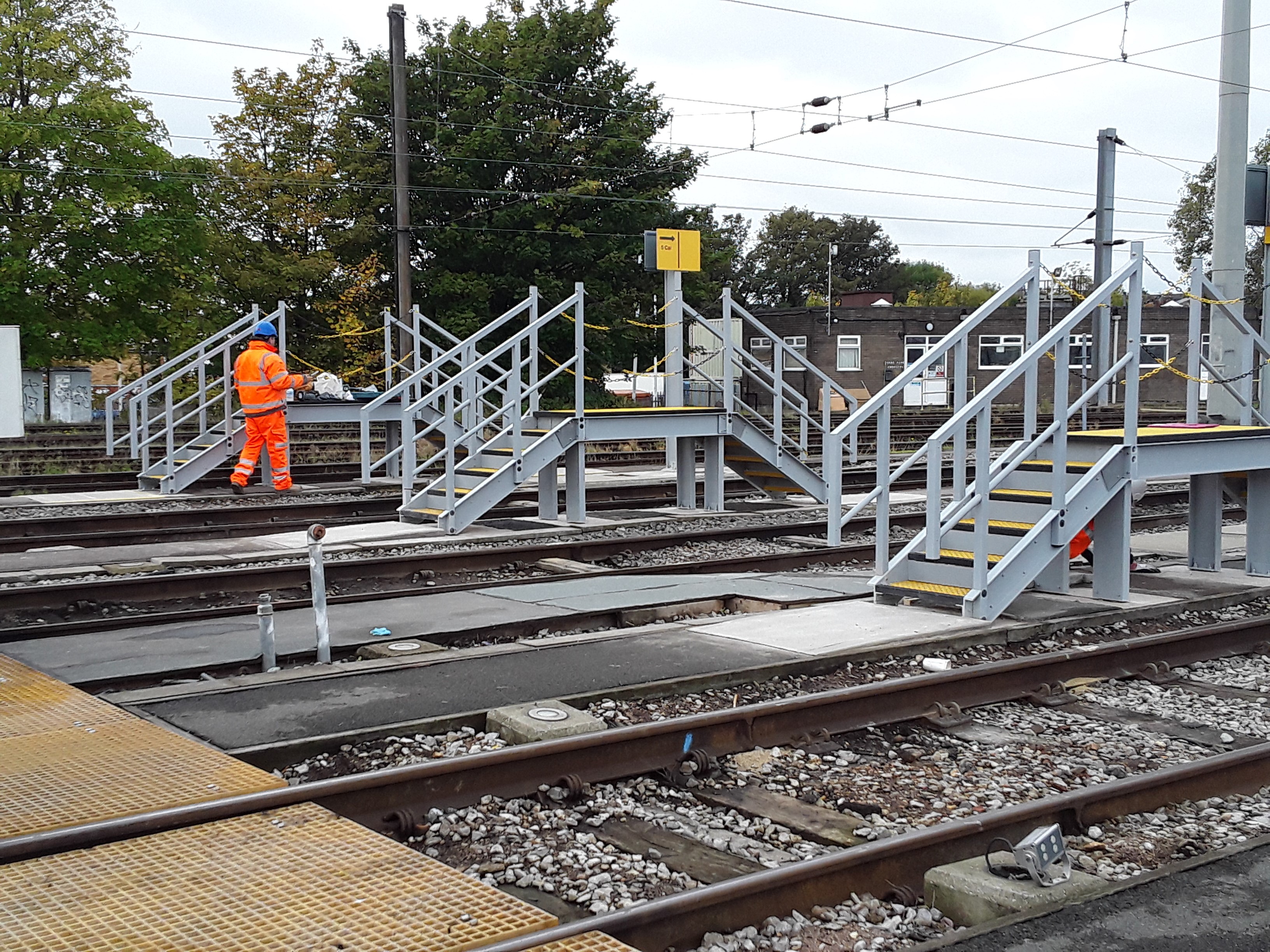
GRP stepovers and hop-overs
Choose the right crossing.
Plan the obstruction, clearances, support positions and maintenance task together.

A stepover is useful when the requirement is to cross an obstruction safely—not simply to gain height.
Pipework, cable routes, ducts, bunds and low-level services often interrupt a pedestrian or maintenance route. A GRP stepover can create a permanent crossing without requiring the obstruction to be relocated. But the fact that a stepover physically fits does not automatically make it the right means of access.
Define what is being crossed
The first design input is the obstruction itself: width, height, operating envelope, insulation, maintenance requirement and whether personnel need access beneath or around it. A pipe that expands, vibrates or requires valve access needs more clearance than a static cable tray.
Hop-over and stepover are not the same thing
For Vital GRP, a small hop-over is a compact crossing for low obstructions with very limited elevation change. A stepover is typically the larger engineered system with several steps and a platform crossing zone. Keeping that distinction clear helps the designer avoid overbuilding small crossings or undersizing more substantial ones.
Frequency of use matters
An occasional maintenance crossing may justify a different arrangement from a route used dozens of times per shift. The more frequent the access, the more important comfort, clear width, consistent stair geometry and the handling of tools or equipment become.
What are users carrying?
If users need both hands for tools, samples or equipment, a steep or cramped crossing may be unsuitable even if the nominal dimensions comply with a minimum envelope. The access solution should reflect the actual task.
Guarding and gates must be integrated
Elevated stepovers may need guardrails, toe boards and self-closing gates depending on geometry and risk assessment. These elements affect clear width and landing space and should be designed as part of the structure rather than added after fabrication.
The obstruction may need future maintenance
A permanent crossing should not prevent a pipe joint, valve, cable tray or duct from being inspected or replaced. In some cases a removable section or different span arrangement may be preferable. Designing around the maintenance envelope avoids turning the stepover into a future obstacle.
Support positions can be the hardest part
The most convenient stair position may land on unsuitable concrete, a drainage channel or another service. Structural supports may therefore need to move outward, span further or connect to an existing structure. This is why the support condition should be considered alongside the crossing geometry.
GRP is particularly useful in wet and corrosive routes
Stepovers appear frequently in treatment works, industrial plants, rooftops and chemical environments where corrosion resistance, anti-slip surfaces and low structural weight can be valuable. An appropriately specified GRP system can be prefabricated and installed without relying on a painted steel corrosion-protection system.
When a stepover is probably not the right answer
- where the route is extremely frequent and a more direct walkway or stair can be created;
- where users regularly move large or heavy equipment across the route;
- where headroom or landing space is inadequate;
- where the obstruction can be removed or rerouted more sensibly;
- where another access method provides materially lower risk.
What does heavy duty mean for this crossing?
Turn the description into a design brief. Record the people, carried equipment, frequency of use and any concentrated or temporary loads. A heavy-duty label alone does not establish the capacity of the deck, steps, connections or supports.
Loading and support
Define distributed and point loads, where they act and the required serviceability criteria. Check the complete load path into the supporting asset. Do not assume the pipe, duct or cable tray being crossed can support the access structure.
Exposure and grip
Identify chemicals, concentration, temperature, weather exposure and likely contamination. Select the resin and surface for those conditions. A gritted finish still needs cleaning and inspection; wet or oily use requires relevant slip-performance evidence.
Electrical interfaces
Review clearances, metallic fixings and the complete assembly where electrical equipment is nearby. Material choice alone does not establish electrical isolation or make work near live equipment safe.
Fabrication and installation
Agree the drawing revision, component arrangement, connections and site assembly sequence. Confirm module sizes against transport, lifting and workface access. Changes to members or support positions require review before manufacture or alteration.
Agree the manufacturing and handover record
Ask how the selected system is fabricated and inspected. A stepover assembled from GRP profiles, panels and connections should be described by its actual construction; do not assume every assembly is made as a single moulded component. Record dimensional checks, connection details and the specified acceptance checks rather than assuming each completed unit has been load tested.
At handover, retain the accepted drawings, permitted use, inspection instructions and any restrictions on future modification. Plan routine checks of surfaces, fasteners, supports and damage. If relocation is needed, review the new support and anchorage conditions before reusing the assembly.
A stepover design brief
- obstruction width and height;
- required clearance above and around it;
- frequency of crossing;
- user activity and carried equipment;
- available footprint;
- support conditions;
- guardrail and gate requirements;
- environment and surface requirement;
- maintenance envelope below;
- delivery and installation constraints.
See Vital’s dedicated GRP Stepover Systems page for the system route.
Choose a stepover because it is the right crossing solution—not simply because there is something in the way.
Have an obstruction that needs a permanent crossing?
Send us the dimensions, drawings or photographs and Vital GRP can determine whether a hop-over, stepover, stair or alternative route is the better engineered solution.
Leave a Reply